
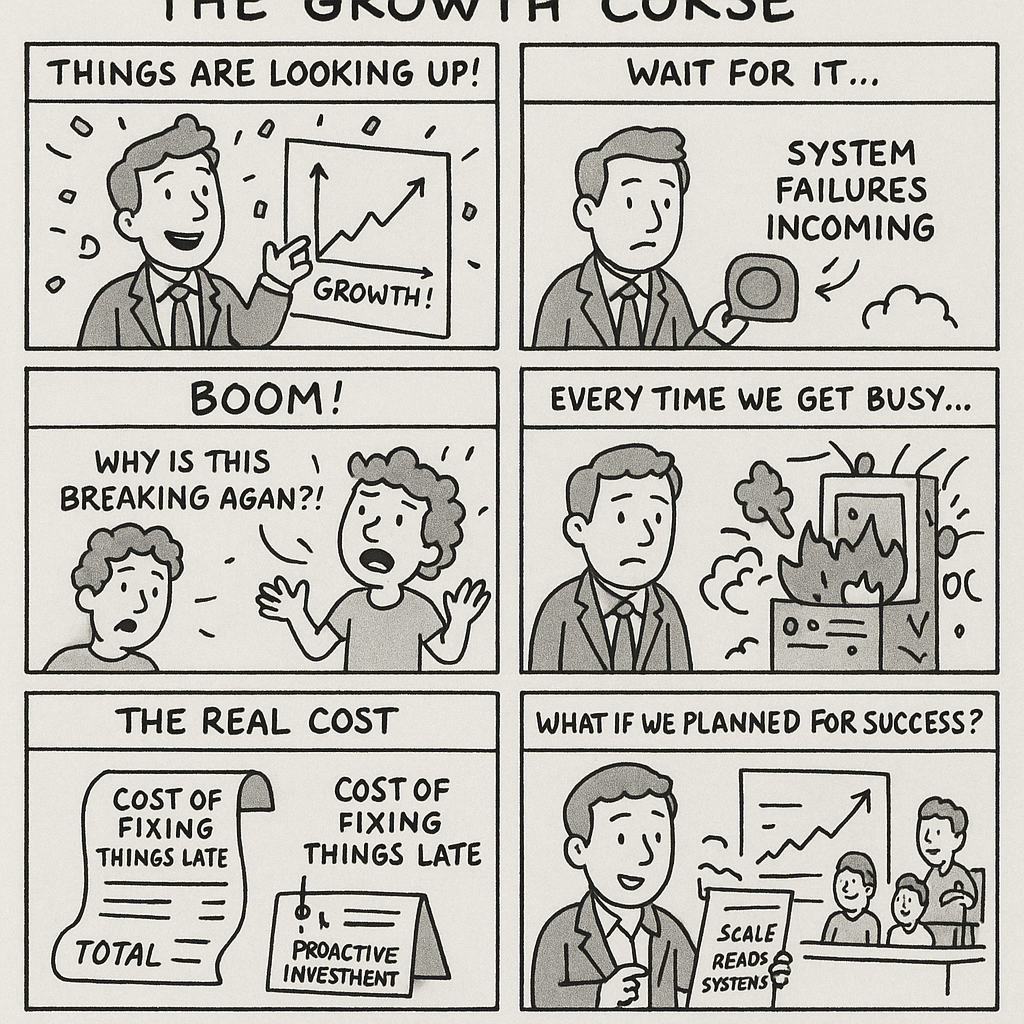
I keep hearing this same frustration from COOs. Different companies, same problem: “Every time we get busy, something breaks. I’m tired of fixing the same problems over and over.”
That’s the most expensive way to learn about your systems.
This conversation comes up constantly because honestly? Growth is supposed to be good news. But every COO I talk to treats the next busy period like a warning sign. They’re not celebrating hitting their targets – they’re bracing for what’s about to break.
The Growth Paradox (Why Success Creates Problems)
The cruel irony is that you get more business, then you can’t handle the business you have.
What worked when you were smaller doesn’t work when you’re bigger. What worked with a tight team breaks when you have more people. The process that made you successful becomes the thing that prevents more success.
I’ve seen this pattern dozens of times. A company builds systems that work perfectly for their current size, then they grow, and suddenly nothing works anymore. Customer onboarding takes twice as long. Quality control starts missing things. Communication becomes a nightmare.
It’s not that the team got worse. It’s that the systems weren’t designed to scale.
The hidden assumption is that processes will naturally grow with demand. But most processes have built-in bottlenecks that only become obvious under load.
What Actually Breaks (And It’s Predictable)
Let me give you some real examples I’ve pieced together from conversations with different operations teams:
Customer Onboarding: Works great when you’re adding a few new clients per month. When you get much busier, the same process means new customers wait weeks instead of days for their first deliverable. The onboarding team is drowning, but nobody knows until customers start complaining.
Quality Control: Manual review process handles normal volume beautifully. When project volume increases significantly, the same reviewers are rushing through everything, missing details they would have caught before. Quality drops, but by the time you notice, you’ve already delivered subpar work to multiple clients.
Communication Workflows: Email chains and weekly check-ins work fine for small teams. As the team grows, information gets lost, decisions get delayed, and nobody knows who’s supposed to be doing what. Projects start falling through the cracks.
The pattern is always the same: the process doesn’t gradually degrade. It works fine, works fine, works fine, then suddenly fails catastrophically.
I’ve seen companies where getting significantly busier meant their delivery time doubled. Not because they got lazy, but because their workflow couldn’t handle the volume.
Why We Keep Rebuilding (The Reactive Cycle)
Here’s what really gets me: we always fix the symptom, never the underlying issue.
Customer onboarding is slow? Hire more onboarding specialists. Quality control is missing things? Add more review steps. Communication is breaking down? Schedule more meetings.
All reasonable responses. All expensive. All temporary.
I asked one COO: “What’s going to break when you get busy again?” He laughed and said “Everything.”
That’s the fire-fighting mentality. You wait for something to break, then you fix it. But fixing broken processes is 10x more expensive than building scalable ones.
The reactive cycle looks like this: get busy → something breaks → fix it → get busy again → something else breaks → fix that. Each time, you’re rebuilding systems under pressure, with unhappy customers, while trying to maintain quality.
Some companies get really good at this cycle. They pride themselves on being “scrappy” and “adaptable.” But scrappy is expensive when you’re doing it every 6 months.
The Cost of Reactive Fixes
The financial cost is obvious: hiring emergency staff, extending timelines, discounting services to apologize for delays.
But the hidden cost is opportunity cost. Every hour spent fixing predictable problems is an hour not spent on actual growth.
One operations team I worked with calculated that they spent 40% of their time each quarter dealing with “growth-related issues.” That’s 40% of their operational capacity going to problems they could have anticipated.
Meanwhile, their main competitor was getting just as busy without the constant breakdowns. Not because they were smarter, but because they built systems that could handle much more volume from day one.
The AI Solution (Predictive Process Design)
AI would probably help here, but not by automating existing processes – by redesigning them to scale.
Most operations teams are flying blind. They don’t know they’re approaching a bottleneck until they hit it. By then, it’s too late to fix it gracefully.
We built something that monitors process capacity in real-time and flags potential issues before they become problems. Instead of waiting for customer onboarding to break when you get busy, the system warns you early that you’re approaching capacity limits.
Here’s what it looks like in practice:
Smart Workflow Routing: Instead of everyone following the same process, the system routes work based on current capacity. High-volume periods get streamlined workflows. Low-volume periods get enhanced quality checks.
Bottleneck Prediction: The AI analyzes historical patterns and flags when specific processes are likely to break. “Based on current trends, quality control will be overwhelmed soon.”
Capacity Planning: Instead of guessing how many people you’ll need, the system models different growth scenarios and tells you exactly when to hire, what skills to look for, and how to structure the team.
One implementation took a client’s customer onboarding from breaking every busy period to scaling smoothly through significant growth.
The Implementation Reality Check
It’s not gonna prevent all growing pains. Some things only break under real load, and you can’t predict everything.
The 80/20 rule applies: you can anticipate and fix 80% of scaling problems before they happen. The other 20% you learn from and build into your next iteration.
Some companies over-engineer for scale they’ll never reach. That’s equally wasteful. You don’t need systems that can handle 1,000 customers when you have 50.
The smart approach is building for more capacity than you currently need, not unlimited capacity. When you hit most of that capacity, you build the next layer.
Also, people resist change when things are working. The hardest time to fix a process is when it’s not broken yet. Your team will ask “why are we changing something that works?”
The answer is: because it works now, but it won’t work at 2x volume.
What This Actually Looks Like
Let me show you a typical before and after from this type of implementation:
Before: Company gets a lot busier. Customer onboarding breaks, quality control breaks, communication breaks. Spend months in crisis mode fixing everything. Revenue growth stalls while they rebuild systems.
After: Same company gets even busier. System flags capacity issues early. They hire and restructure proactively. Onboarding time actually improves because they optimized the process for higher volume.
The difference? Instead of getting busy then breaking, they anticipated the growth and built systems to handle it.
The unexpected benefit was that their team went from dreading growth to welcoming it. Instead of “oh no, we’re growing again,” it became “our systems can handle this.”
The Scaling Mindset Every COO Needs
One take is: if you’re always fixing the same types of problems, you’re not fixing the problem.
The question worth asking isn’t “how do we fix this breakdown?” It’s “what’s going to break next, and how do we prevent it?”
Most COOs can predict exactly what will break during their next busy period. Customer onboarding will slow down. Quality will slip. Communication will get messy. The same things that broke last time.
That predictability is actually good news. It means you can fix these problems before they happen.
Start with the bottlenecks you can predict. Map the processes that consistently fail under load. Build systems that work when you’re busier than you are now.
The companies that scale smoothly aren’t the ones that never have problems. They’re the ones that solve problems before they become crises.
The Competitive Reality
Meanwhile, some companies are scaling without the constant breakdowns. Not because they’re lucky, but because they designed their operations for growth from the beginning.
I was working with a client who was losing deals because their onboarding process took 6 weeks. Their main competitor was onboarding similar clients in 10 days. Same complexity, same service level, completely different systems.
The difference? The competitor had built onboarding workflows that got faster with volume, not slower.
When operational efficiency becomes a competitive advantage, reactive fixes aren’t just expensive – they’re strategically dangerous.
The Question That Changes Everything
The simple question every COO should ask: “What’s going to break when we get busy again?”
Not “if we get busy,” but “when we get busy.” And not “will something break,” but “what will break.”
Most operations teams know the answer. The customer onboarding process that’s already showing strain. The quality control step that’s taking longer each month. The communication workflow that’s getting messier as the team grows.
That knowledge is power. Instead of waiting for things to break, you can fix them while they’re still working.
But yeah, having success that creates problems… that’s the kind of problem you want to solve systematically, not reactively.
Curious about what’s going to break during your next busy period? The patterns are probably more predictable than you think.